One Letter from the Lodz Ghetto (1940): Reconstructing the History of the Wojdysławski Family
Sometimes a single archival document is enough to open an entire family history. In the records of the Lodz Ghetto, such moments are not uncommon — yet each leads to a different, deeply individual story.

While researching archival collections in the State Archives in Lodz, I came across a letter written in 1940 by two children, Ela and Jerzyk Wojdysławski (Wojdyslawski). This letter is part of a broader body of wartime documentation from the Łódź Ghetto. Related materials, including indexed employment applications and administrative records, are available in the archival indexes published on this site www.jewishlodz.com/indexes The letter was addressed to Chaim Rumkowski, the Head of the Jewish Council in the Łódź Ghetto. In it, the children ask for work to be assigned to their parents.
"My name is Ela Wojdysławska. There are four people in our home: Daddy, Mommy, me, and my younger little brother Jerzyk. Daddy has no money, and soon we will not have anything to eat. My Mommy’s maiden name is Eizner. Dear Mr. Rumkowski!!!We know that you are very, very kind, so we kindly ask you to give a job to Mommy or Daddy. Our parents do not know that we are writing to you. We believe that you will fulfill our request."
It is a short document, similar in form to many other petitions preserved from the early period of the ghetto. Yet it contains one crucial detail: an address.
Why Work in the Lodz Ghetto Was a Matter of Survival
From the very beginning of the Łódź Ghetto, work played a role that went far beyond earning a living. It was a fundamental element of the ghetto’s functioning and one of the key conditions for survival. The ghetto was conceived by the German authorities as a closed, economically “productive” entity, in which labor determined one’s perceived usefulness.
Employment meant access to food ration cards and, in some cases, slightly better rations. Even in 1940, at this early stage of the ghetto’s existence, securing work could protect entire families from immediate destitution and marginalization. Although the mass deportations would come later, the link between work, food, and survival was already firmly established.
Seen in this context, the Wojdysławski children’s letter was not a routine administrative request. It was a strategic and deeply personal attempt to stabilize the situation of their family under rapidly deteriorating living conditions.
The Address as a Starting Point
The address cited in the letter appears under pre-war street names. This seemingly minor detail is of critical importance when working with Łódź Ghetto records. Following the German occupation, street names were systematically changed, and the ghetto administration consistently used the new German nomenclature.
Only by accounting for this change was it possible to correctly identify the family’s place of residence. Św. Jakuba Street, known before the war, functioned during the occupation as Rembrandtstraße. Without translating the address into its wartime equivalent, the letter would have remained disconnected from other administrative records.
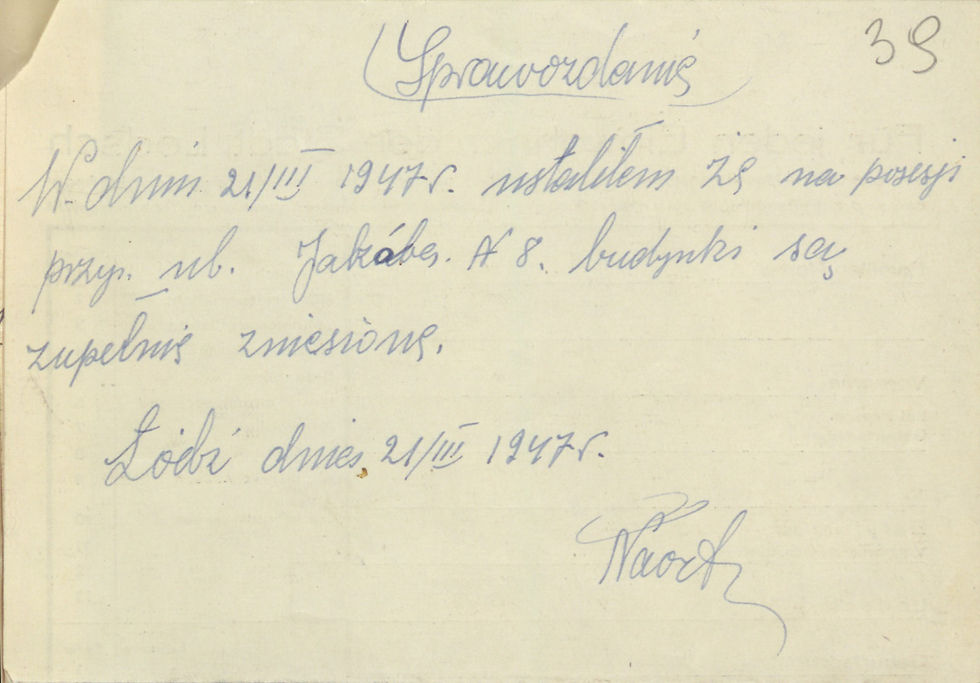
Once the address was properly identified, it became possible to locate the Wojdysławski family in the ghetto residents’ registers. For the first time, the parents’ names emerged clearly: Gawryl Wojdysławski (Wojdyslawski) and Itta Ajzman. What began as an anonymous petition could now be anchored in a specific household, at a specific location, at the very beginning of the ghetto period.
Names and Identity — A Major Challenge in Jewish Genealogy
Tracing Jewish families through wartime and pre-war records is often complicated by the instability of names. Linguistic shifts, phonetic spellings, transliterations from Yiddish and Hebrew, and administrative practices mean that the same individual may appear under several different names across documents.
In this case, the mother appears in the letter under the surname Eisner, while in other records her name is recorded as Ajsner. The children known from the letter as Ela and Jerzyk bore the Jewish names Estera Malka and Jankiel Ichok. The father appears as Gawryl, but in other documents his name is rendered as Gabriel.
Only by cross-referencing multiple sources — the 1940 letter, ghetto resident lists, registration cards, and civil records — was it possible to confirm that all these variants referred to the same family. Without accounting for such variations, many archival traces would remain invisible or incorrectly attributed.
Reconstructing Life Before the War
The ghetto resident lists provided a gateway to earlier, pre-war documentation. A preserved registration card made it possible to trace the family back to previous generations, identifying Gawryl’s parents and siblings and reconstructing the broader household structure before the war.
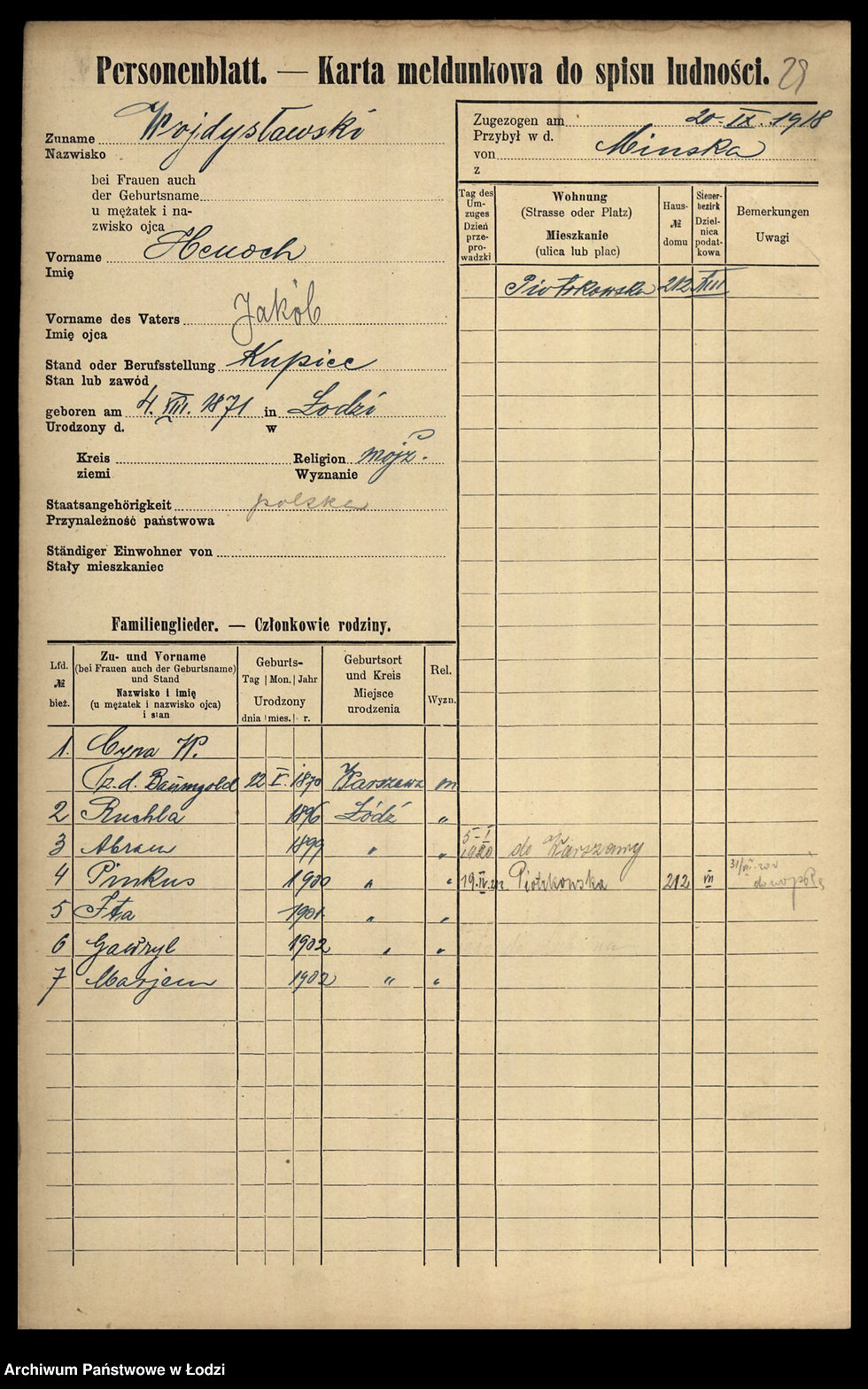
Held at the
These records show that Gawryl Wojdysławski (Wojdyslawski) worked as a clerk before the war and was the son of a merchant — a profile characteristic of the Jewish urban middle class in interwar Łódź. Further documentation revealed the marriage record of Gawryl Wojdysławski (Wojdyslawski) and Itta Ajzman, registered in Łódź in 1925, completing the pre-war chapter of the family’s history.
The Wojdysławski Family — A Large and Well-Established Jewish Family in Pre-War Lodz
The collected records reveal that the Wojdysławski family was well known, respected, and remarkably extensive within the Jewish community of Łódź. Members of the family appear across numerous administrative sources spanning several generations and different branches.
The family lived not only in Lodz but also in other cities, including Warsaw. This geographical spread, combined with clear intergenerational continuity, points to a high degree of social stability and community integration before the war. Through careful comparison of records, it was possible to connect the children mentioned in the 1940 letter with the wider, multi-generational family network, reconstructing relationships that wartime documentation often fragments.
The sources further suggest that the family maintained strong religious traditions, while simultaneously participating in modern urban and administrative life. This combination was characteristic of segments of the Jewish clerical and merchant elite of the Second Polish Republic — a milieu to which the Wojdysławskis most likely belonged.
From a Single Letter from the Lodz Ghetto (1940) to a Family History

The 1940 letter written by two children became the key to reconstructing the history of an entire family — from pre-war Łódź, through the earliest phase of the ghetto, to the fragmented administrative traces left behind. Without attention to changing street names, name variants, and archival context, these documents would have remained isolated pieces rather than parts of a coherent story.
This is how the archives of the Lodz Ghetto often function: seemingly minor documents allow multiple record groups to be connected into a single narrative. From names, addresses, and handwritten requests emerge people, relationships, and lives interrupted by history.
It is in moments like these that the archive ceases to be a collection of files and becomes a place where names — and families — are recovered. For genealogical research, these fragments are never merely documents — they are often the only remaining traces of lives once fully lived.


Comments