Jewish Genealogy in Lodz
- JewishLodz
- Jan 11
- 4 min read
The Specific Challenges of Researching Jewish Family History
Jewish genealogy in Lodz differs in important ways from genealogical research conducted in other parts of Poland. The city’s rapid growth in the nineteenth century, its complex municipal administration, an

d the rupture caused by the Second World War produced an exceptionally rich — yet challenging — archival landscape.
For many researchers, Jewish family history from Lodz begins with fragmentary information: a surname, an approximate place of origin, or a family story preserved without documentation. Understanding the specificity of local archival sources is therefore essential for effective genealogical research.
Lodz as a Unique Genealogical Environment
From the nineteenth century until the outbreak of the Second World War, Łódź developed into one of the most important centres of Jewish life in Central Europe. Industrialisation attracted large-scale migration from surrounding regions, creating a highly mobile and diverse Jewish population.

This demographic growth generated extensive municipal documentation. Jewish residents were registered repeatedly for administrative purposes, resulting in a dense archival record that today forms the core source base for Jewish genealogy in Lodz.
At the same time, this administrative richness created complexity: individuals often appear across multiple record series, years, and offices, making genealogical reconstruction both promising and demanding.
Municipal and Administrative Records as Key Sources
Unlike genealogical research in rural areas, which often relies primarily on vital records, Jewish genealogy in Lodz depends heavily on municipal and administrative documentation.
The most significant record types include:

residence registration cards and address records,
identity card applications and supporting documentation,
civil registration records
employment records, occupational certificates,
and professional registrations,
population registration files and municipal census materials,
voter lists and electoral registers,
burial cards and cemetery records,
taxpayer lists and fiscal registers,
property ownership files, tenancy records, and real estate inventories,
labor and work identification cards from the Łódź Ghetto,
as well as many other administrative and archival record types.
Many of these documents contain photographs, physical descriptions, addresses, places of birth, and family relationships. Such records are invaluable for reconstructing individual lives, particularly where civil or religious registers are incomplete or unavailable.
Name Variants and Linguistic Challenges
One of the defining challenges in researching Jewish family history from Łódź is the

variability of personal names. Jewish residents appear in archival records under multiple linguistic forms — Polish, German, Russian, and occasionally Yiddish.
Names were often recorded phonetically, resulting in inconsistent spelling across documents. A single individual may therefore appear under several variants of the same name, sometimes even within a short period of time.
This makes exact-name searching unreliable and requires a flexible research strategy informed by historical and administrative context.
The Impact of the Second World War
The creation of the Lodz Ghetto and its liquidation fundamentally disrupted the archival trail of Jewish families. While some ghetto-era records survive, they are often fragmentary and preserved separately from pre-war municipal files.
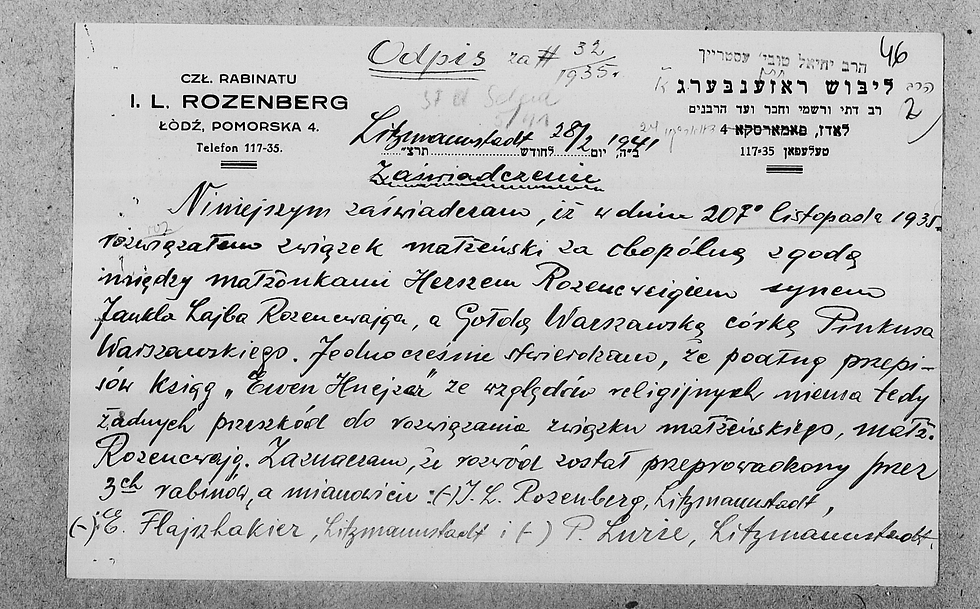
As a result, pre-war documentation frequently constitutes the most stable foundation for Jewish genealogy research. Postwar records — including death confirmations, witness testimonies, and inheritance proceedings — may supplement this material and help reconstruct the final chapters of individual lives.
Why Indexed Archival Records Are Essential for jewish genealogy in Lodz
The sheer volume and dispersion of archival records related to Jewish residents of Lodz can be overwhelming, especially for researchers unfamiliar with Polish archival systems.
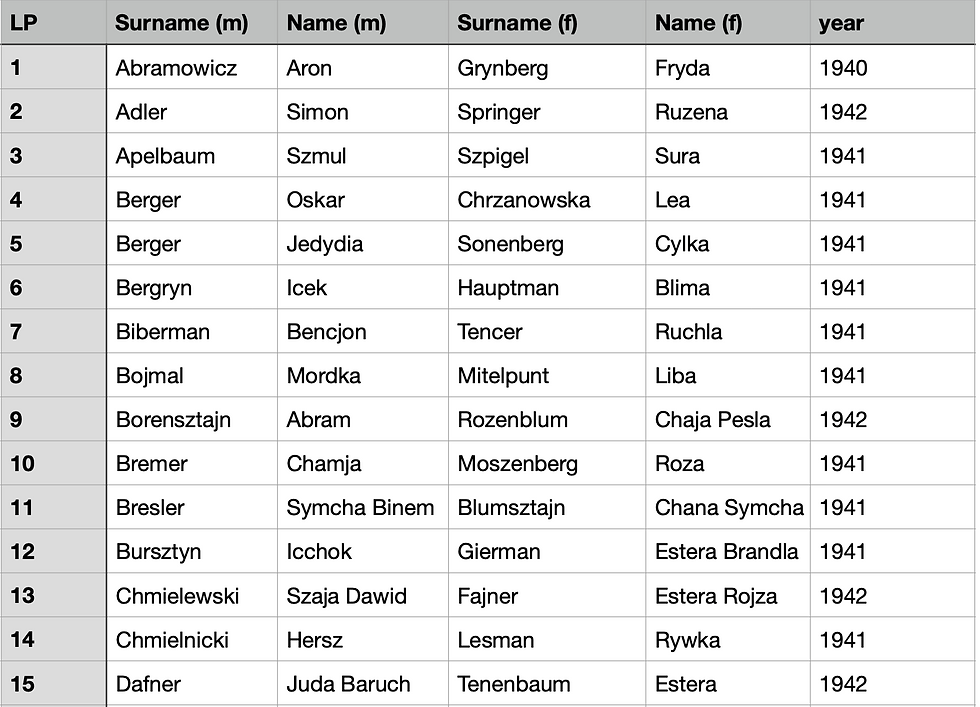
Indexed archival records play a crucial role at this stage. Indexes do not replace original documents; instead, they indicate whether a person appears in a specific archival collection and where that documentation is held.
For many researchers, establishing this presence is the essential first step. Without it, genealogical research risks becoming unfocused and inefficient.
Those beginning research may consult the Index Collections, which identify individuals within selected archival sources and help determine where original documentation may be found. These indexes provide a structured point of entry into the complex archival landscape of Jewish genealogy in Lodz.
Independent Research and Archival Navigation

Jewish genealogy research in Lodz often combines independent archival work with interpretive guidance. Even when records are publicly accessible, understanding archival references, record group structures, and historical terminology requires specialised knowledge.
Language barriers further complicate research, as many records are preserved in Polish using administrative vocabulary unfamiliar to contemporary researchers. In such cases, contextual interpretation of key information may be necessary to assess a document’s relevance.
This type of guidance supports independent research rather than replacing it, helping researchers proceed with clarity and confidence.
Jewish Family History as Archival Reconstruction

Jewish genealogy in Lodz is rarely a linear process. It involves assembling fragments from multiple sources, reconciling inconsistencies, and situating individuals within a broader historical framework.
Family memory often preserves relationships without dates, while archives preserve dates
without stories. Genealogical research bridges this gap by connecting remembered lives to documented evidence.
For many families, the result is not a complete narrative, but a clarified structure — a foundation upon which further research can be built.
Archival Records and Jewish Genealogy in Lodz
Municipal and administrative records preserved in Polish archives form the core source base for Jewish genealogy in Lodz. When systematically indexed and carefully interpreted, these records allow individual lives to be reconstructed with precision and historical accuracy.
Jewish genealogy research often begins with a name. In Lodz, it continues through archives that still preserve the traces of lives once woven into the city’s fabric.


Comments