Employment Applications from the Lodz Ghetto | Jewish Family History Records
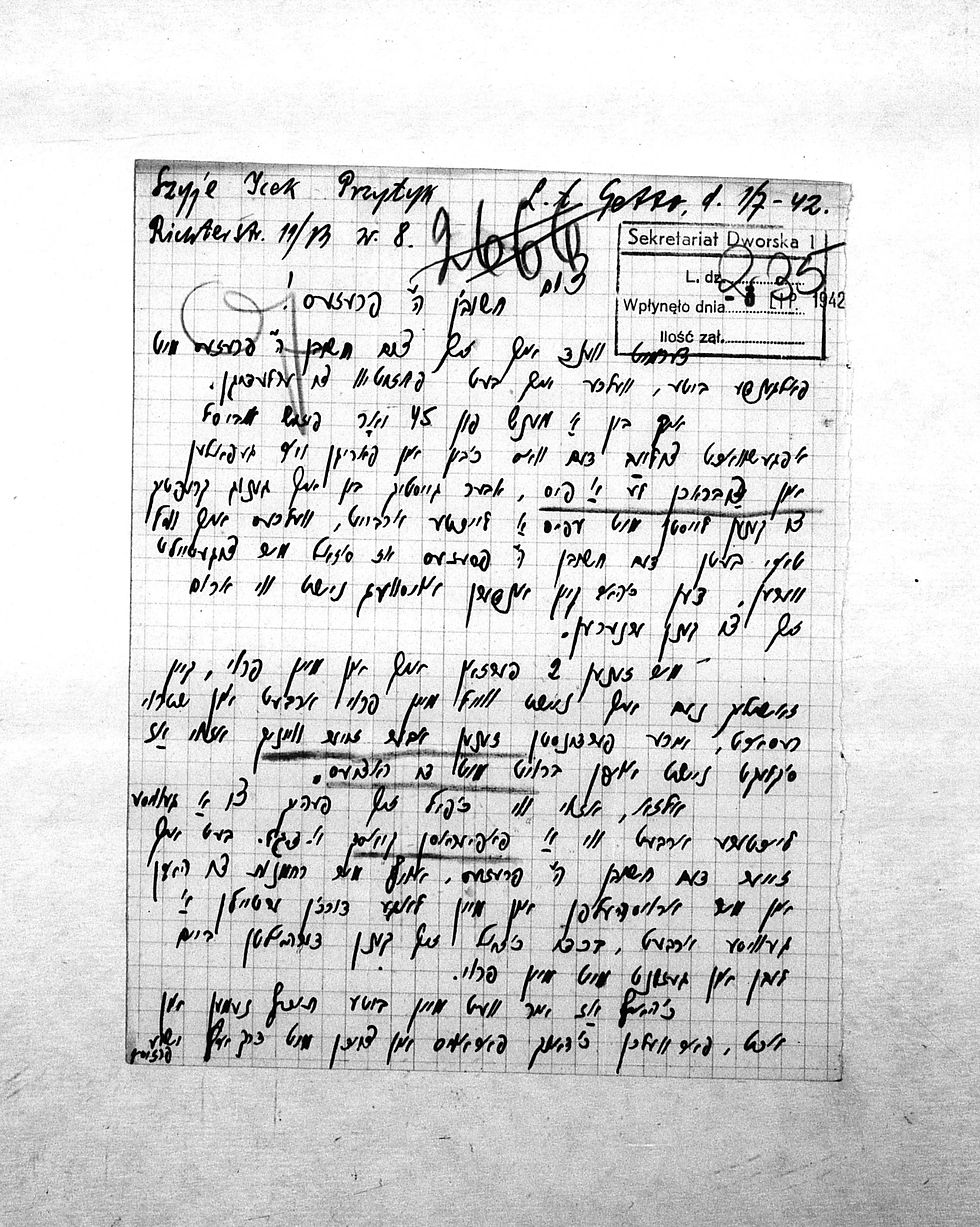
Among the surviving records of the Lodz Ghetto (Litzmannstadt Ghetto), a particularly significant group of documents consists of employment applications submitted by Jewish residents to the ghetto administration. Although formally administrative in nature, these records today serve as some of the most revealing sources for Jewish genealogy in Lodz and for understanding everyday life under conditions of extreme coercion.
Preserved primarily in the State Archives in Lodz, these documents provide rare insight into both individual biographies and collective strategies of survival.
What were employment applications in the Lodz Ghetto?
Employment applications were requests addressed to the ghetto authorities—most often to offices subordinate to Chaim Rumkowski, the Head of the Jewish Council in the Lodz Ghetto. They were submitted by women and men, and at times even by children, either on their own behalf or in the name of entire families.

Work in the ghetto was not merely a means of earning a wage. In many cases, employment meant access to food rations, temporary protection from deportation, and a greater chance of survival. As a result, these applications were often written under conditions of acute desperation.
The preserved files reveal that applications were drafted in multiple languages—Polish,
German, Yiddish, and Hebrew—reflecting the pre-war social structure of Jewish Lodz, diverse educational backgrounds, and earlier administrative experiences of the ghetto’s inhabitants.
What can genealogists learn from these documents?
From the perspective of Jewish family history research, employment applications from the Lodz Ghetto are exceptionally valuable. They often contain information that is otherwise fragmented or missing from other record groups.
These documents may provide evidence of:
a person’s confirmed presence in the ghetto at a specific moment in time, crucial for reconstructing family timelines,
names of family members, sometimes including spouses, children, or dependents,
pre-war and ghetto addresses, enabling researchers to trace forced relocations,
occupational history and professional skills, including crafts, trades, or previous employment,
education and training, occasionally described in notable detail,
place of origin, including towns and regions outside Lodz.
In many cases, a single application connects multiple generations and locations, making it

one of the most informative Lodz Ghetto records for genealogical reconstruction.
Administrative records as human testimony
Beyond their factual value, employment applications also function as deeply personal testimonies. While written in an official or restrained tone, they frequently allude to illness, poverty, the loss of family members, or responsibility for children and elderly relatives.
These documents reveal how families attempted to navigate an inescapable system, using the limited tools available to them—professional identity, education, past social standing—in the hope of securing work and survival.
In this sense, employment applications occupy a critical space between bureaucracy and lived experience. They demonstrate how individuals sought to preserve dignity, family cohesion, and continuity of life within the confines of the Lodz Ghetto.
Why do these records matter today?

For contemporary researchers and descendants of Jewish families from Lodz, employment applications are more than administrative artifacts. They are documents of agency under extreme constraint, recording decisions made in moments of uncertainty and fear.
They confirm presence, clarify relationships, and illuminate professional and educational backgrounds—but they also testify to the ways in which families attempted to survive, protect one another, and assert their humanity.
Indexed Employment Applications from the Lodz Ghetto
The index currently includes the applicant’s full name and the year the employment application was submitted. It allows researchers to quickly determine whether a specific name of interest appears in the surviving employment application records from the Lodz Ghetto.
The index is intended as a reference and discovery tool, helping to establish the presence of an individual in the ghetto documentation before undertaking more detailed archival research.
The index is a work in progress and is continuously expanded as additional files are examined and processed. 👉 [Download the index of employment applications from the Lodz Ghetto]

Comments