Sporting Life in Jewish Lodz: Bar-Kochba and Jewish Genealogy Lodz
When thinking about Jewish Lodz in the interwar period, industry, trade, schools, and political movements usually come to mind. Less often remembered is the fact that the city was also a vibrant center of Jewish sport and physical culture. Yet for many young Jews, sport was an essential part of everyday life — a space of modernity, social participation, and identity-building.
One of the most important expressions of this phenomenon was the Jewish Gymnastic and Sports Society Bar‑Kochba Lodz, one of the largest and most influential Jewish sports organizations in the city.
The Beginnings of Jewish Sport in Lodz
At the turn of the twentieth century, sport was gaining popularity throughout Europe. Within Jewish communities, physical activity was viewed not merely as recreation, but as a meaningful social and educational practice. Gymnastics, athletics, and team sports were meant to strengthen the body, foster discipline, and create a sense of collective belonging, while also challenging long-standing stereotypes about Jewish physicality.
Lodz, one of the largest Jewish population in Europe, provided fertile ground for such initiatives. Early Jewish sports associations emerged before the First World War, laying the foundation for a more unified and organized Jewish sports movement in the years that followed.
The Formation of Bar-Kochba
The Jewish Gymnastic and Sports Society Bar-Kochba was established in 1917 through the
merger of two earlier organizations:
the Lodz Jewish Gymnastic and Sports Society “Bar Kochba,” founded in 1912,
the Jewish Gymnastic and Sports Society “1913,” active since 1915.
This consolidation made it possible to create a strong, multi-section club that would become one of the central institutions of Jewish sporting life in Lodz. Bar-Kochba remained active until 1939.
Bar-Kochba within Official Sports Structures
Bar-Kochba was not a marginal or isolated club. It was fully integrated into both Jewish and Polish sports structures. The society belonged to, among others:

the World Union of Jewish Gymnastic and Sports Societies “Maccabi,”
the Polish Athletic Association,
the Polish Football Association,
the Union of Polish Cycling Societies,
the Polish Boxing Association.
Thanks to this affiliation, Bar-Kochba athletes competed in official leagues, championships, and national competitions, alongside clubs from across Poland.
In the photograph: Ceremony of the consecration of the banner of the Łódź Jewish Gymnastic and Sports Society “Bar Kochba” — fragment of the banquet; from the left: gentlemen Dr. Leser (chairman of the Jewish Council for Physical Education), Mrs. Falk, Dr. Falk, A. Kon, Mrs. Prybulska, and Dr. Silberstrom.
Fragment of the procession organized on the occasion of the opening of the cycling season; the orchestra of the Bar-Kochba cycling section.
Sports Sections and Everyday Activity
The society maintained a broad range of sports sections, including:

gymnastics,
boxing,
athletics (wrestling, weightlifting),
football (soccer),
cycling,
table tennis,
track and field.
Training sessions and competitions were important social events, attracting not only athletes but also their families and supporters. Sport became part of the rhythm of everyday Jewish life in Lodz.
Known Athletes and Named Members of Bar-Kochba Lodz
Only a limited number of Bar-Kochba athletes are known today by name, mostly through sports press reports and later historical research. Among the best-documented figures associated with the club are:
Majer M. Wajngarten (Weingarten) — Polish champion and record holder in weightlifting (bantamweight division) in the late 1920s and early 1930s.
Minc — Polish champion and national record holder in the middleweight category in 1930 (first name not preserved in available sources).
Boruch Winnykamień — athlete associated with the club’s strength and wrestling sections.
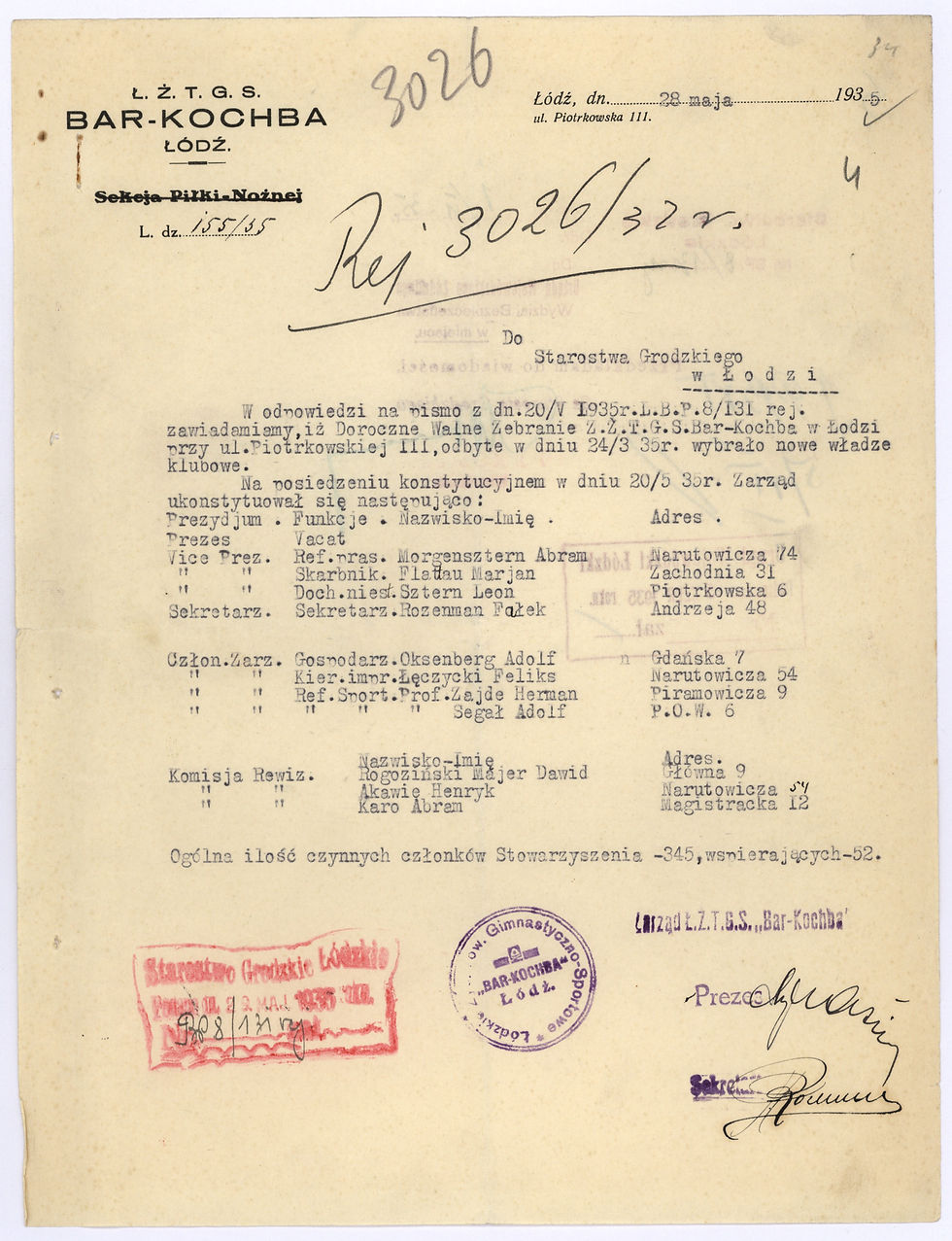
The absence of full membership lists highlights the importance of alternative sources — especially newspapers — for reconstructing individual biographies and family histories connected to Jewish sport in Lodz.

In the photograph: the Bar-Kochba athletic team won the Łódź District Championships in weightlifting. Standing from the left are: Mr. M. Cwillich, head of the section; Sztern, Minc, Suchwolski, Krieger, Winnykamien, Zylberbaum, Wajnwurcel, and Wajngarten.
M. Wajngarten, a five-time Polish champion, won the Łódź District Championship for the sixth time, setting a new Polish record in the two-handed snatch (75 kg) and in the overall total (247 kg).
Athletic Success and Wider Influence
Bar-Kochba was particularly renowned for its strength sports. The club produced several national-level competitors and was regarded as one of the leading centers for weightlifting and wrestling in interwar Poland.
Its influence extended beyond competition results. In 1926, the wrestling section of Bar-Kochba participated in the founding of the Polish Athletic Federation, underscoring the role Jewish athletes played in shaping Poland’s national sports institutions.
The Symbolism of the Name

The name “Bar-Kochba” was chosen deliberately. Simon Bar Kokhba, the leader of the Jewish revolt against Rome (132–135 CE), became a symbol of strength, resistance, and Jewish self-assertion in modern Jewish culture. For many young Jews, sport embodied these ideals in a contemporary form — physical capability combined with cultural and national pride.
Sports clubs bearing the name Bar-Kochba were founded not only in Lodz, but also in Warsaw and Upper Silesia, forming part of a broader network of Jewish athletic organizations in Poland.
A History Interrupted
The activity of Bar-Kochba, like all Jewish sporting life in Lodz, came to an abrupt end in 1939. The later fates of its athletes and activists became intertwined with the history of the Litzmannstadt Ghetto, forced labor, deportations, and emigration. Today, the club survives primarily through archival traces — documents, press references, and a small number of surviving photographs.
Newspapers as a Key Source for Jewish Genealogy in Lodz
One of the most valuable sources for researching Jewish genealogy, Jewish roots, and pre-war Jewish life in Lodz is the local press of the interwar period, both Jewish and general city newspapers.

Interwar Lodz newspapers contain a remarkable range of material: match reports and competition results, photographs of athletes and teams, feature articles and sports reportage, short news items from everyday city life, obituaries and death notices, as well as announcements, advertisements, and community notices.
For genealogists and family historians, these newspapers often preserve details that do not survive in official records. A single press mention can connect a person to a street, a workplace, a sports club, or a wider network of relationships.
When read alongside archival documents, the press allows researchers to place Jewish sport within the broader social fabric of the city — linking athletic activity with families, institutions, and specific places in Lodz. In this way, newspapers become not only a source for sports history, but a powerful tool for rediscovering the everyday lives behind the names.


Comments