Jewish Genealogy Lodz: Why Your Family Surname May Look Different in Polish Records
Jewish genealogy in Lodz requires understanding how Jewish surnames evolved in 19th-century Poland.
Surnames became fixed relatively late
Permanent hereditary surnames among Jews in the Polish lands were introduced mainly at the end of the 18th and the beginning of the 19th century, in the aftermath of the Partitions of Poland (1772–1795).

After the Polish-Lithuanian Commonwealth was divided between Austria, Prussia, and Russia, each partitioning power introduced its own administrative regulations. These included the obligation for Jewish populations to adopt fixed, hereditary surnames for taxation, military conscription, and civil registration.
As a result, many Jewish families in the territories of former Poland began using permanent surnames during this period - although the process was gradual and not always consistent.
Before surnames became fully stabilized, identification was often based on patronymics - derived from the father’s name.
In 19th-century civil records, you may encounter forms such as:
👉 Mosze Aronowicz (son of Aron)
👉 Rywka Jakubowicz or Jakubówna (daughter of Jakub)
These were not originally hereditary surnames in the modern sense.They simply meant “child of.”
However, in many cases these patronymic forms gradually transformed into fixed family surnames and remained with the family for generations. This is why today we encounter surnames such as: Aronowicz, Berkowicz, Jakubowicz, Joskowicz, Moszkowicz.
Originally meaning “son/descendant of Aron, Berek, Jakub, Josek, Moszek” they later became permanent hereditary surnames.
During this transitional period, one person might appear under a patronymic in one record and later under a fixed surname — sometimes even derived from that same patronymic.
The language of the records changed
Łódź was located in the Russian partition throughout the 19th century.

After the January Uprising (1863), Russian became the mandatory administrative language.
📜 From 1868 until 1915, civil records in the Kingdom of Poland were written in Russian, using Cyrillic script.
This adds another layer of complexity:
Names were transliterated into Cyrillic.
The same surname may look very different when converted back into Latin script.
Many records were written by Polish clerks using Russian as an administrative language.
As a result, the Russian used in these documents is often grammatically inconsistent and sometimes difficult to interpret - even for native Russian speakers today.
Reading such records requires not only knowledge of Russian, but also familiarity with historical orthography and administrative formulas.
Some surnames indicate place of origin
Many Jewish surnames are toponymic - derived from towns or regions.

Examples include:
Opatowski (from Opatów)
Poznański (from Poznań)
Warszawski (from Warsaw)
Wrocławer (from Wrocław)
Such surnames often indicate where a family originally came from - not necessarily where they later lived. A person named “Warszawski” could have lived in Łódź for generations.
Other surnames derive from professions or characteristics
Some surnames originated from:
occupations
social roles
descriptive traits
sometimes even nicknames
Many Ashkenazi surnames reflect trades, objects or symbolic meanings. In some cases, surnames were assigned administratively when they became compulsory.
What about surnames like Kohen or Lewi?
Names such as: Kohen / Cohen / Kohn / Cohn / KahnLewi / Levy / Lewin / Levin / Levine have a distinct origin.
They refer to ancient priestly or Levitical lineage within Jewish religious tradition:
Kohen (Cohen) indicates descent from the priestly class (kohanim).
Levi (Lewi) indicates descent from the tribe of Levi.
Related Ashkenazi surnames include:
Katz - derived from the Hebrew acronym Kohen Tzedek (“righteous priest”)
Segal / Segan / Segel - from Segan Levi (“assistant of the Levites”)
By the 19th century, however, these functioned as hereditary surnames. Civil and administrative records rarely confirm ritual status. In archival practice - including documents preserved in the State Archives In Lodz - these names appear like all others: subject to spelling variation, Cyrillic transcription, and clerical inconsistencies.
Spelling was not stable
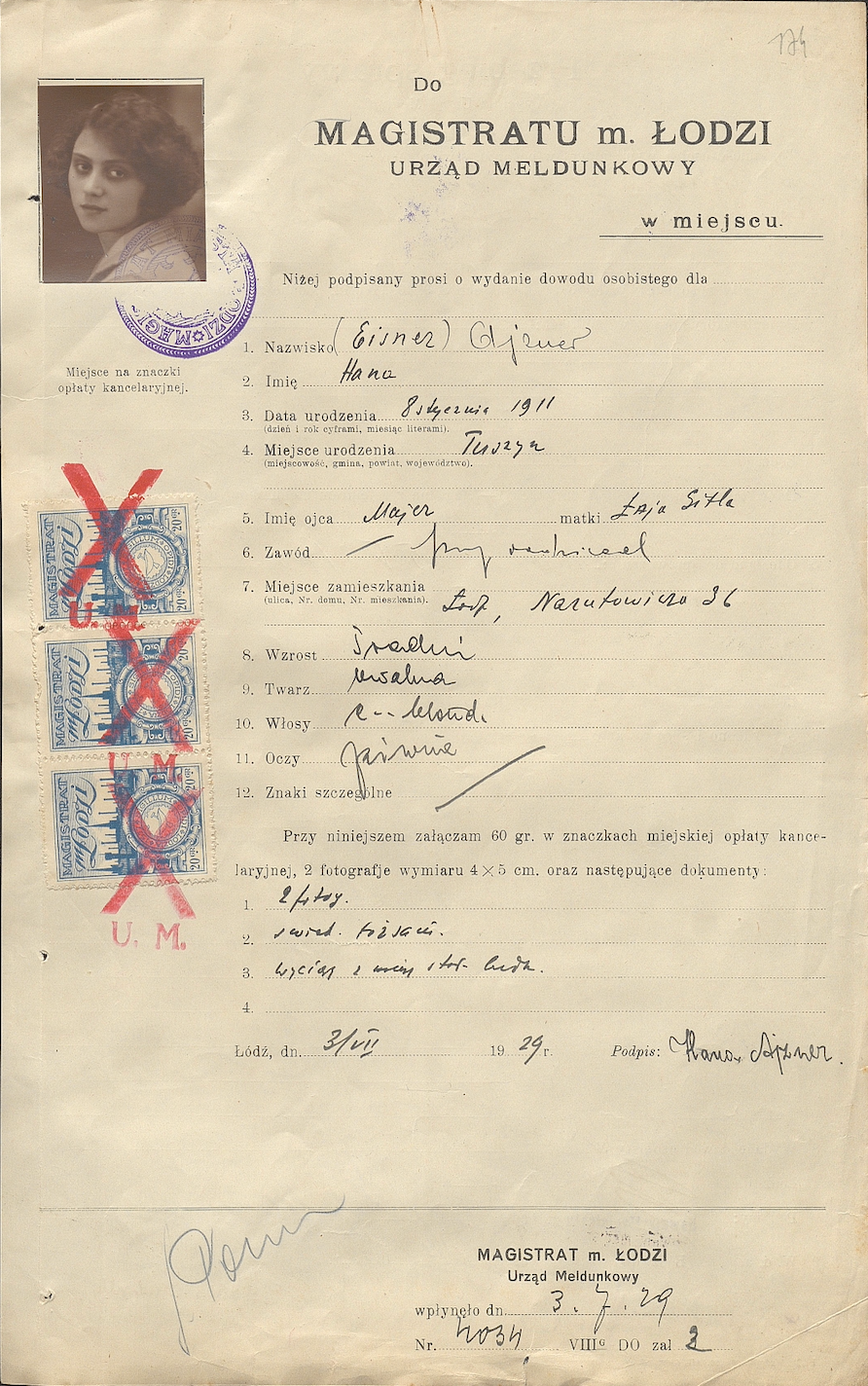
The same individual might appear as:
Ajzner / Eisner
Sztajnfeld / Steinfeldt
Wajnberg / Weinberg
Wiener / Winer
Spelling depended on:
language of administration (Polish / Russian / German)
phonetic interpretation by clerks
literacy level
personal preference
Sometimes even the same person signed their surname differently in different documents.
Polish grammatical endings change the form
In 19th- and early 20th-century Polish civil records, women’s surnames were sometimes written with grammatical endings:
-owa → wife of
-ówna → daughter of
So one family might appear as:
Ajzner / Ajznerowa/ Ajznerówa and Eisner / Eisnerowa / Eisnerówna
Sztajnfeld / Sztajnfeldowa / Sztajnfeldówna and Steinfeldt / Steinfeldtowa/ Steinfedtówna
Wajnberg/ Wajnbergowa/ Wajnbergówna and Weinberg / Weinbergowa / Weinbergówna
Wiener / Wienerowa / Wienerówna and Winer / Winerowa / Winerówna
These are not different families - they are grammatical forms.
If you search only for one version, you may miss important records.
Research requires flexibility - linguistic, historical, and archival awareness.
When researching Jewish ancestors from Lodz, you are not just searching a surname. You are navigating layers of language, history, and administration.
If you only have a surname and approximate dates, that is often enough to begin your Jewish genealogy research in Lodz.
Start with the free surname indexes here: https://www.jewishlodz.com/indexes-2
If you need guidance in identifying variants, understanding historical forms, and locating archival files - I’m here.


Comments